
Disclaimer: This article was originally published on the now-defunct DoubleScoop website and is republished here to preserve access to the content.
Unseen Territories
By Scott Dickensheets
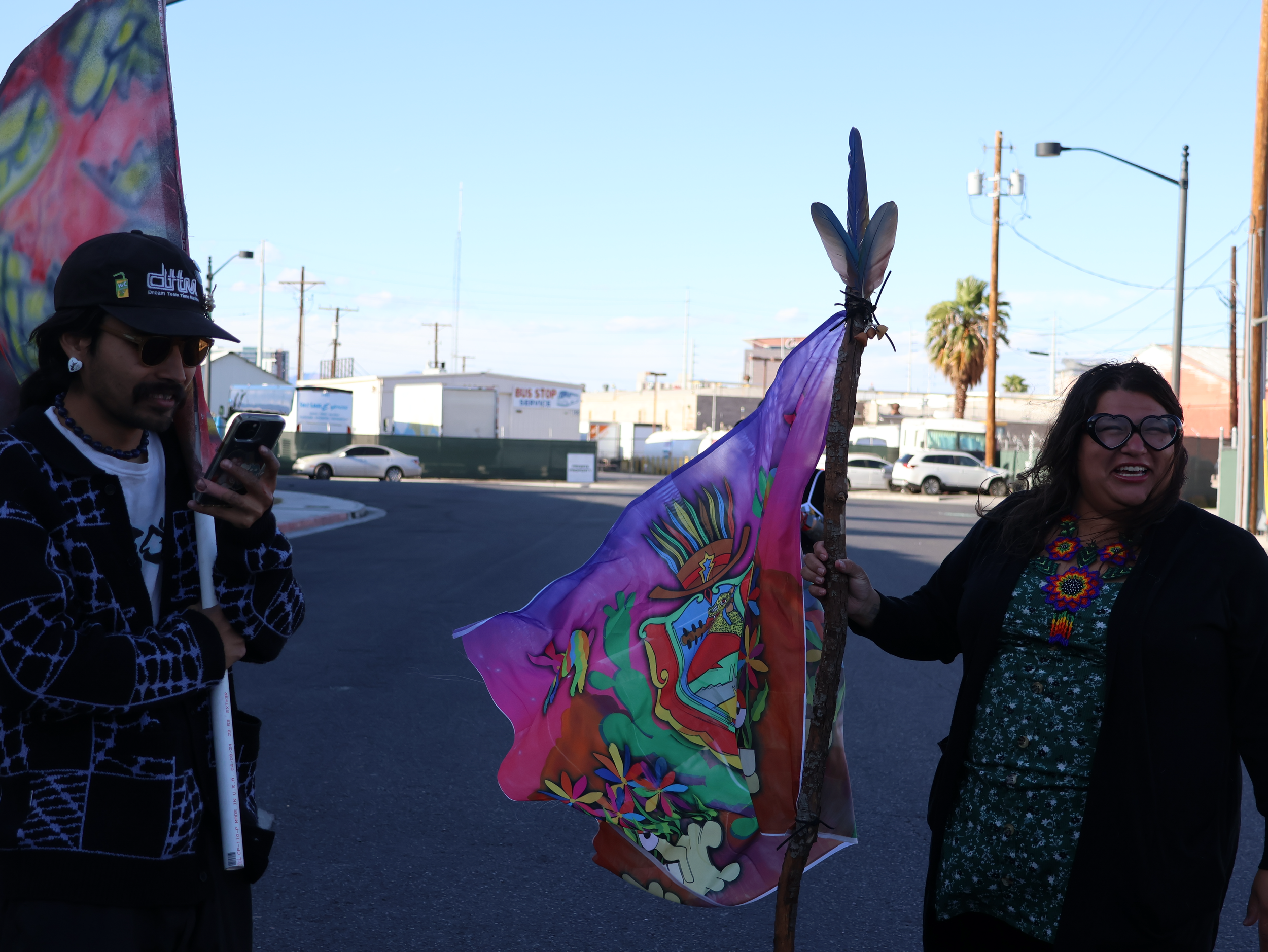
To any pedestrians who saw it on that Sunday afternoon, April 27, the eight-car phalanx rolling along Main and Fremont streets must’ve seemed enigmatic even by the standards of downtown Las Vegas. People hanging out of the cars’ windows or emerging through sunroofs, waving obviously handmade, artisanal flags — 14 in all, while shouting and laughing. No context, no explanation, just ebullient expression on the move.
So here’s the context: It was the public debut of Unseen Territories, a group art project in which Las Vegas curator Sydney Galindo got 14 BIPOC artists to create their own distinctive flags. A promenade like this was on her mind pretty much since she concocted the idea a year ago. “I always knew it was going to be a community performance piece,” Galindo says — bringing these personalized flags into ordinary spaces, brazenly encroaching on the city’s normalcy with voices of the repressed. “This is not about asking to be seen,” says a voiceover on a video of the event posted on Unseen Territories’ fundraising page. “This is about showing up — loud, full of wonder, and rooted in lineage.”
The 14 artists include Brent Holmes (a Double Scoop contributor), Lance Smith, Emily Sarten, Hue, and Xochil Xitlalli. Their flags range from intensely personal explorations of their heritage to overt political statements: One reads “Unassimilable,” while another declares, “No one is illegal on stolen land.” Seeing this, a quick-witted sidewalk observer of the car parade might’ve accurately grokked the project’s broad outlines: personalized flags in various flavors of resistance hoisted against some of the harsher meanings that have accrued to the American flag — or to the idea of national flags in general — in this moment of peak political tumult: Colonialism. Inequity. Domination and repression. “The notion of flag as a demarcator of place, culture, and identity comes with incredible gravity,” Holmes says. And not everyone feels included in those demarcations.
“During my undergrad in Art History,” Galindo says, “I was tired of seeing BIPOC narratives presented as optional — as add-ons or afterthoughts to a white western canon. We are expected to study their expressions in full, but ours are often merely ‘appreciated,’ never fully understood or valued. That’s not right.” Unseen Territories is her clapback.
As it happens, the caravan was actually a midpoint in the project: Video from the event is being worked into a documentary by Galindo and an artist/videographer Shahab Zargari. “When I was first approached about the project, I didn’t know if I had enough time,” says the busy and ubiquitous Zargari. But because he’d already met many of the artists from previous video projects, he knew “the interviews would be low- pressure with the possibility of getting some truly outstanding and honest storytelling for the final product. That and, well, I feel like being a part of the project is being on the right side of history.” He and Galindo, who’s credited as director, plan to have the documentary done this summer. “The endgame,” Galindo says, “is to put it in film festivals, take it on the road.”
The artists had their own reasons for participating. “I felt it was important to be a part of this project because we are entering a chapter in America where voices are being silenced,” Sarten says, “and artists have a responsibility to speak out against fascism. We have to be loud.” Smith: “I joined this community project because we are living in a moment of existential crisis for marginalized communities, particularly for trans and gender- nonconforming people.” Across the country, trans people are facing challenges to their identities, healthcare, and physical safety; queer flags have been prohibited in some places (although Salt Lake City and Boise, Idaho, are trying to skirt state laws, have just adopted Pride flags as official city standards). “My approach to creating this flag was to interrogate the very idea of what a flag can be. It is not just a piece of cloth; it is a living, breathing testament to survival and resistance. ... It is a flag of devotion — not to a nation, but to the idea of collective liberation.”
For her part, it’s important to Galindo that this act of resistance be rooted in a sense of elation, for artists “to reconnect and feel joy with their ancestors, their process, their community. And for the audience, to reclaim wonder.” In addition to Unseen Territories, Galindo has established an informal organization called Artist Resistance Through Solidarity (ARTS). It’s not an official nonprofit. Rather, it’s Galindo’s DIY response to the vagaries, inequities, and excessive hoop- jumping that plagues so much arts funding and support. Since August, ARTS has awarded 21 $100 microgrants that’ve helped creatives cover small but necessary aspects of their work. There’s no elaborate submission process, no red tape, and no follow-up paperwork justifying how the money was spent. Just direct support. It’s a measure of Galindo’s commitment to ground-up advocacy that she’s funded these grants herself.
As for what’s next with Unseen Territories, she’s working to set up a gallery showing. But in her most ambitious vision, the documentary eventually paves the way for similar flag projects elsewhere, spreading the joyous resistance. For the moment, though, speaking a few days after the downtown caravan, Galindo’s criteria for success seemed pretty straightforward: “Seeing how excited the artists were made me so happy.”